Mainstream formulas
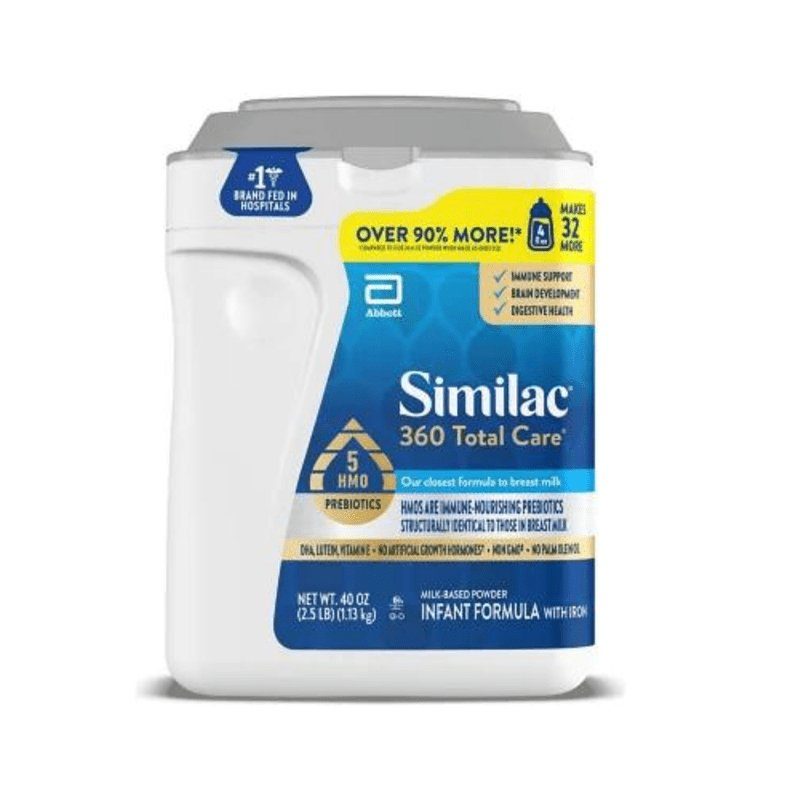
Similac 360 Total Care Infant Formula (Non-GMO Powder, 30.8 oz) — Similac (Abbott)
Draft · Unpublished
| Product | Similac 360 Total Care Infant Formula (Non-GMO Powder, 30.8 oz) |
|---|---|
| Maker | Similac (Abbott) |
| Category | Mainstream formulas |
| Size / format | Birth to 12 months. 30.8 oz non-GMO powder can (also RTF 2/8/32 fl oz). |
| Observed price | $49.99 |
| Price source / date | Target · 2026-09-22 |
| Price confidence | indexed |
| Recall status | No exact-model recall found in consulted sources for window 2023-09-22 to 2026-09-22. CPSC database not directly queryable via available tools — status is unchecked, never cleared. |
If your baby was born in an American hospital, the odds are good their first bottle was Similac. The 360 Total Care line is Abbott's flagship — "the #1 brand fed in hospitals" — and its signature feature is the one competitors keep chasing: an exclusive blend of 5 human milk oligosaccharides, prebiotics structurally identical to those in breast milk. That's the science-forward pitch: immune support, brain development, digestive health, non-GMO, no artificial ingredients, all in one mainstream can.
The HMO story is genuinely the most interesting thing in American formula right now. HMOs are the third-largest component of breast milk, and they feed beneficial gut bacteria — which is why every premium brand now races to add them. Similac's claim is five of them, structurally identical, in a non-GMO base. Whether that translates into a meaningfully healthier baby than Enfamil's MFGM/DHA stack is the kind of question pediatric nutrition researchers debate and parents can't resolve — but the ingredient is real, the mechanism is plausible, and the hospital endorsement gives it institutional weight.
What's genuinely good is the breadth of the line. Powder, ready-to-feed in three sizes, sensitive variants, the 360 Total Care Sensitive for lactose-related fussiness — it's a full system, and parents can move between formats without switching brands. The CVS reviews for the RTF bottles are a love letter to convenience: travel, outings, 3 a.m. feeds, perfectly portioned, no mixing. The recommend rates (86–90% across aggregations) and the FoodsCo 4.83/86 confirm this isn't hype-dependent — it's infrastructure.
What's actually wrong is smaller but worth saying. The RTF bottles are photographed with nipples and don't include them — multiple reviewers flagged it, and Similac's consumer team replies with customer-service phone numbers, which tells you it's a real irritant. Several CVS reviews were collected as part of a promotion, so the praise corpus isn't fully organic. And the price: $49.99 for the 30.8 oz powder is a dollar or two under Enfamil's equivalent but a mile over store brands. You're paying the Abbott tax for the HMO stack.
The social pulse is institutional trust with a side of irritation. Similac parents are less evangelical than the import crowd and less bargain-hunting than the store-brand crowd — they're the parents who took the hospital's recommendation and stayed. The nipple-packaging complaint is the kind of specific, repeated, fixable gripe that signals an otherwise satisfied base.
The value call: at $1.62/oz the powder undercuts Enfamil Gentlease slightly and beats every European import by a wide margin, while adding the 5-HMO blend neither US competitor matches at this price. Against store brands (~$1.10–1.40/oz for comparable nutrition), you're paying roughly 20–40% more for HMOs and the hospital pedigree. WIC covers Similac in many states, which can zero out the premium entirely.
Skip it if your baby thrives on a cheaper formula — HMOs are a nice-to-have, not a must-have. Buy it if you want the most science-forward mainstream American formula with the broadest format range, or if your hospital started you on it and switching feels like fixing what isn't broken. The honest tradeoff: the institutional default with a real ingredient edge, packaged with one packaging annoyance Abbott really should fix.
The Target review corpus adds useful texture. Parents praise the smooth mixing — no clumping — and the packaging details like the scoop holder, with several calling it their "go to formula." The recurring complaints are gas and constipation in some babies, the standard adjustment-period grievance for any formula switch. Abbott's own product guide confirms the 30.8 oz can (list 68654) alongside 20.6, 36, and 40 oz sizes, so the per-ounce math improves if you buy bigger — though the 30.8 oz at $49.99 ($1.62/oz) is the common middle ground.
The powder-versus-ready-to-feed economics deserve a line. The same Target listings show 360 Total Care RTF at $10.99 for six 8 oz bottles — convenient for travel and night feeds, punishing for the wallet as a daily driver. Powder mixed in batches is the economical route, as one verified reviewer put it: "great option for your dollar." And the safety fine print from Abbott's guide: powdered formula isn't sterile, shouldn't go to preemies or immune-compromised infants without doctor direction, and never warms in a microwave.