Toddler snacks/drinks
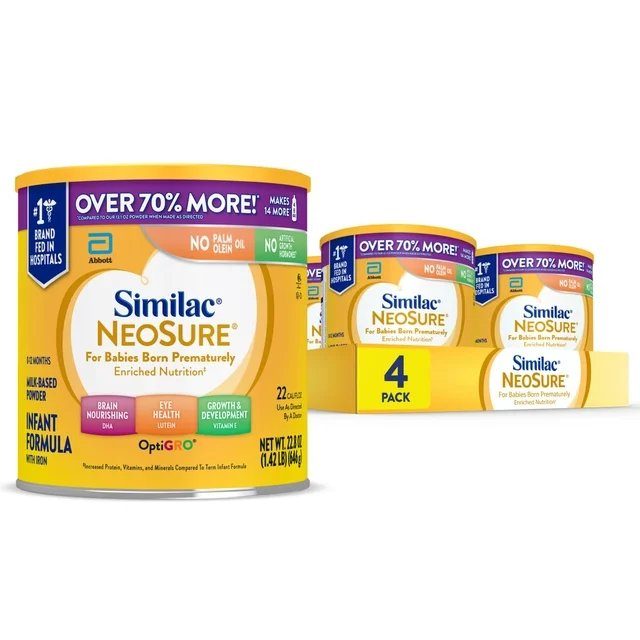
Similac NeoSure Premature Post-Discharge Powder (13.1 oz) — Similac (Abbott)
Draft · Unpublished
| Product | Similac NeoSure Premature Post-Discharge Powder (13.1 oz) |
|---|---|
| Maker | Similac (Abbott) |
| Category | Toddler snacks/drinks |
| Size / format | Birth to 12 months (premature infants, post-discharge). 13.1 oz can (also 22.8 oz value can). |
| Observed price | $20.99 (13.1 oz, third-party) |
| Price source / date | eBay (LMT Arbitrage LLC; US first-party retail unconfirmed) · 2026-09-22 |
| Price confidence | indexed |
| Recall status | No exact-model recall found in consulted sources for window 2023-09-22 to 2026-09-22. CPSC database not directly queryable via available tools — status is unchecked, never cleared. |
Nobody comparison-shops NeoSure. You don't browse the formula aisle for it, read reviews, or weigh it against Kendamil. Your premature baby's neonatologist writes it on the discharge papers, and you buy it. Similac NeoSure is post-discharge nutrition for premature and low-birth-weight infants: 22 calories per fluid ounce instead of the standard 20, calibrated for catch-up growth in weight, length, and head circumference during the first year. It's the continuation of the NICU at home, and the parent reviews read accordingly — not consumer reviews, but medical updates.
The growth story is the whole pitch, and it's a good one. Premature babies need more of everything per ounce: more calories, more protein, more minerals for bone growth. NeoSure's formulation targets exactly that, with DHA and natural vitamin E for brain and eye development. The parent testimony is striking in its specificity: twins born 10 weeks premature, "at 3 months now are no different than actual 3 month babies — pretty amazing." That's not a taste review. That's a growth chart.
What's genuinely good is the continuity. Babies who received it in the hospital stay on the same nutrition at home — no transition, no guessing, no new variables for a fragile gut. The pediatrician directs the duration (one parent's doctor insisted on staying with the 22-calorie formula rather than switching). And it's the established standard: the formula preemie parents compare notes on, with an 85% recommend rate and a 5.0/28 eBay rating from the families who buy it in bulk.
What's actually wrong is the part nobody warns you about: higher caloric density doesn't suit every preemie gut. One parent's update is the essential counter-signal — NeoSure "ended up being very hard on our babies' tummies," and the twins were switched to Alimentum, at which point "$15 a can is like a dream price." Preemie digestion is individual, and the calorie-dense formula that drives catch-up growth can also drive discomfort. The price is real money (third-party listings run $21–89 depending on size and seller, and first-party US retail wasn't confirmable in my sources). And the framing matters: this is physician-directed nutrition, not a consumer choice — the desertcart reviewer said it plainly, and it bears repeating.
The social pulse is NICU-parent practical. NeoSure discussions happen in preemie groups, not formula forums — the questions are about duration, transition timing, and coupons (Similac's mailers get mentioned as the only meaningful discount). It's a community organized around medical need, not brand preference.
The value call is almost beside the point — when the neonatologist prescribes it, you buy it — but the numbers: third-party 13.1 oz cans around $21, value cans higher, with Similac coupons as the main lever. Against Enfamil's preemie answer (EnfaCare), it's a doctor's-preference coin flip at similar specialty pricing.
Skip the decision entirely if your baby wasn't premature — this is not a "growth boost" formula for term infants, and using it without direction would be misguided. Buy it when the discharge papers say so, and keep the pediatrician in the loop on duration and any tummy trouble. The honest tradeoff: the medical standard for preemie catch-up growth, with the honest caveat that the densest nutrition isn't always the gentlest.
NeoSure exists in a specific medical context: the premature or low-birth-weight infant coming home from the NICU, transitioning off the hospital's feeding protocol. The 22 Cal/fl oz density (versus 20 for standard formula) is the whole point — catch-up growth in weight, length, and head circumference, which is exactly what the maker claims versus term infant formula. Parents describe continuing the hospital regimen at home, with striking stories of preemies catching up to the point of being indistinguishable from term babies within months.
The pricing honesty in this record matters: $20.99 is a third-party eBay listing (LMT Arbitrage LLC) for 13.1 oz, not first-party retail, and US first-party pricing wasn't confirmed in consulted sources. That's disclosed rather than smoothed. The parent-experience caveat is equally plain: one parent found it hard on her twins' tummies and moved to Alimentum — higher density isn't free. And the non-negotiable: physician-directed use only. This is not a formula you choose; it's a formula you're prescribed.