Adaptive & sensory gear
Gonge River Stones — Gonge
Draft · Unpublished
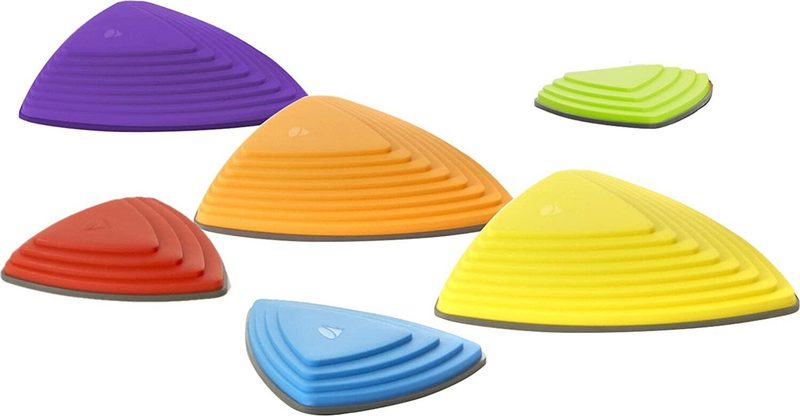
| Product | Gonge River Stones |
|---|---|
| Maker | Gonge |
| Category | Adaptive & sensory gear |
| Size / format | Ages 2 and up; weight limit 220 lbs; 3 large + 3 small stones. |
| Observed price | $65.99 |
| Price source / date | Wayfair (indexed; sale price — compare across retailers) · 2026-09-22 |
| Price confidence | indexed |
| Recall status | No exact-model recall found in consulted sources for window 2023-09-22 to 2026-09-22. CPSC database not directly queryable via available tools — status is unchecked, never cleared. |
The floor is lava. Every parent knows the game, and Gonge built the official equipment for it: six chunky triangular stepping stones that turn any living room into an obstacle course. They've been a staple of OT clinics, preschools, and PE classes for years, and the reason is simple — kids will jump between them for an hour while building balance, coordination, and the confidence to judge distances.
Each stone is a triangle with sides of varying steepness, so no two approaches feel the same. Three large stones, three small, six colors. Scatter them in a line, a circle, or a zigzag; the difficulty changes with the layout, which is why the same set works for a wobbly 2-year-old and a daredevil 7-year-old. The rubber rim on the base is the unsung hero — it grips the floor so stones don't slide mid-jump and protects hardwood from the inevitable crashes. And they stack for storage, which any parent of bulky toys will appreciate more than they'd like to admit.
What's genuinely good in practice: the 220-pound weight limit. That's not a typo — these hold adults, which means parents and therapists can demo, join in, and not worry about the big kid in the class. The PP plastic with TPE rubber edging is genuinely tough; these live in schools and clinics and survive. The open-ended play is the real value — reviewers across OT-resource shops describe kids inventing games for months: color-callout jumping ("jump on blue! now spell it!"), lava courses, timed runs. It's a gross-motor toy that accidentally teaches colors, letters, and turn-taking.
The complaints are practical, not existential. First: price roulette. The identical 6-stone set lists at $65.99 on Wayfair, $82.99 at ToysRUs, and $88.99 at a special-needs retailer. Same stones. Shop around — the spread is over $20 for no reason. Second: the steep sides are genuinely challenging for young toddlers; a 2-year-old will need the stones close together and flat-side-up at first. Third: they're not the prettiest toy in the living room. Functional plastic in six bright colors is the aesthetic, and it is what it is. Fourth: on very smooth floors, even the rubber rims have limits if a kid launches sideways — supervise the daredevils.
The social pulse is settled and warm. This is institutional gear — OTs, PE teachers, preschools buy it by the set, which is the strongest possible signal for durability. Parent reviewers describe the same arc: bought for balance concerns or rainy-day energy, stayed for the imaginative play. There's no real debate about whether they work; the only conversation is price-shopping between retailers.
Value call: at $65.99 on sale at Wayfair, it's a fair price for clinic-grade gear that lasts years and serves multiple kids. At $88.99, you're paying a specialty-retailer premium for the same plastic — buy the cheaper listing. Against foam stepping stones (cheaper, lighter, less stable) or the premium Stapelstein set (lighter, pricier, more versatile), the Gonge sits in the sensible middle: the workhorse.
Bottom line: the rare "educational" toy that kids actually choose over the tablet. Buy it on sale, scatter the stones, and let the lava game begin.
The honest buying frame. River Stones pay off inside a specific window: the years when balance is still under construction and the weather keeps everyone indoors. A child who already scrambles confidently across playground climbers gets less from them — this is equipment for building the skill, not displaying it. Floor space is the practical constraint nobody mentions: six stones laid out as a course claim real square footage, and in a small home they'll live stacked in a corner between sessions. That's fine as long as you expect it. The price math works per year of use, not per stone — a set that serves from toddlerhood through preschool costs less annually than most of what cycles through the playroom in between. At checkout, confirm the set size: smaller starter sets suit one young toddler, larger ones suit siblings or a playroom. And put them on a washable surface first, because the first thing any toddler does is carry them somewhere unplanned.